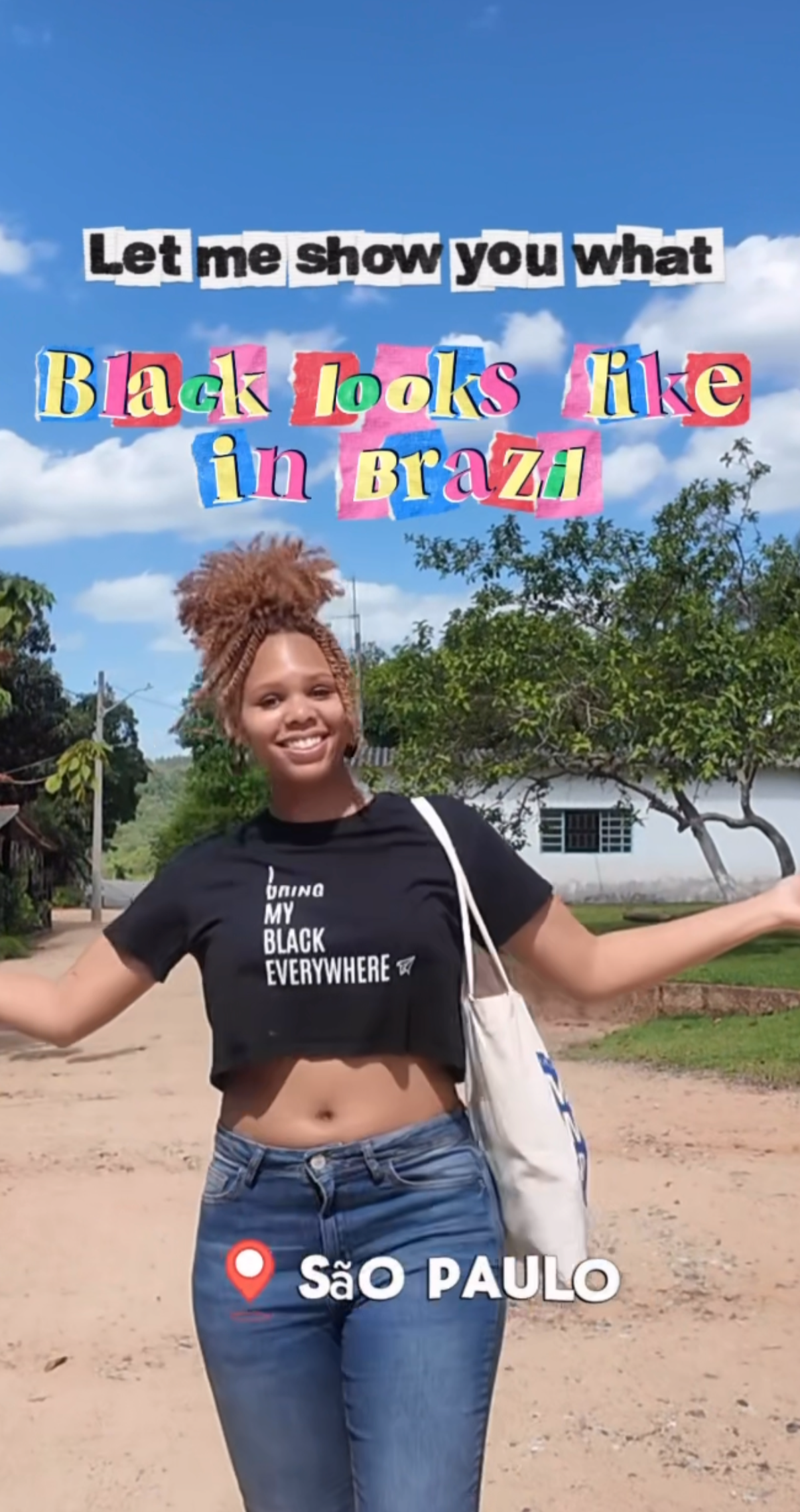
I had been to São Paulo before. Several times, actually. Enough times to think I knew what kind of city it was: big. fast, and a little intimidating.
So when I was invited back by Visit São Paulo to take part in the launch of the second Afro Guide, led by the State Secretariat of Tourism (SETUR), alongside the Municipal Secretariat of Tourism, I’ll be honest— I was a bit skeptical. I hadn’t been back since before COVID, and my last memories of São Paulo were shaped by a city where I noticed the stares more than the smiles, and where I rarely saw people who looked like me.
What I didn’t expect was to realize how much had always been there— I simply hadn’t been shown how to see.
São Paulo:
Seeing What Was Always There
Hosted by Visit São Paulo, Secretary of Tourism Sao Paulo, and Secretary of Municipal Tourism
Why This Moment in São Paulo Actually Matters
For a long time, Black culture in São Paulo has existed without being fully acknowledged. It’s been present in the labor, the neighborhoods, the music, the bodies moving through the city—but not always in the way the city tells its own story. Representation hasn’t been absent because Black history isn’t here. It’s been absent because it hasn’t been centered, funded, or consistently protected in the public narrative.
That’s why this moment is different.
Seeing the state and city of São Paulo not only acknowledge Afro-Brazilian history, but actively invest in Afro-tourism—financially, structurally, and politically—carries real weight. This wasn’t a single event meant to check a box. It was clear through the press conference, the second generation of itineraries, the museums, and the partnerships that an understanding is forming: black tourism has power, and Black stories deserve to benefit from it directly.
What stood out to me most was that Afro-tourism here isn’t being treated as an add-on. It’s being positioned as essential. As something that validates legacy, educates visitors, creates economic opportunity, and finally connects the dots between São Paulo’s Black past and its present. That speaks to hope—especially in a country where Black contributions have long been visible, yet quietly sidelined.
Afro-Tourism, Power, and Being in the Room Where Change Is Discussed
My trip began with a press conference hosted by Visit São Paulo and the State Secretariat of Tourism (SETUR), alongside Hubber Clemente and Solange Bar, the organizers leading new Afro-tourism initiatives across São Paulo.
Afro-tourism officially began taking shape in São Paulo in 2023. We were brought into the room as Black media, Black storytellers, and Black travelers to be participants in how Afro-tourism is being framed, funded, and expanded the city. City and state leaders spoke openly about representation, and about why tourism cannot be separated from the people who live there.
What stood out to me most was hearing city officials say plainly that, “When we do tourism, we don’t do it alone. We do it for the people.” That framing matters.
That Afro-tourism isn’t just about statues or museums, It’s about education, legacy, economic impact, and visibility.
Two additional cities even approached us afterward, asking to be included next time—which told me everything I needed to know. This movement is growing, and people are paying attention.
I Had to Rethink “I’m Not a Museum Person”
One of the most impactful stops was the Afro Brasil Museum, located inside Parque Ibirapuera, a massive public park where people were walking, running, playing, and simply living.
The museum itself was founded by a Black, man named Emanuel Araújo, who spent decades collecting and curating more than 3,000 pieces of Afro-Brazilian, African, and Afro-diasporic art. Paintings, sculptures, historical artifacts come together to tell stories that are often erased or minimized.
As someone who usually avoids black history museums because I find they focus heavily on slavery, I was already guarded. A woman named Jennifer Tosch—who leads Black Heritage tours in Amsterdam—once told me that when it comes to history, “it’s not the story itself, but the storyteller that can make or break an experience.” That day, we had a powerful storyteller in Raphaellie.
We didn’t just learn about slavery—we learned about labor, skill, queerness, resistance, and survival. I was especially struck by learning that, unlike in the United States, some enslaved people in Brazil were paid for the skills they brought from Africa. That distinction alone shifted how I understood Brazil’s version of Black history.
This experience opened my eyes to approaching Black history in other countries with curiosity, rather than apprehension or exhaustion.
When Museums Feel Like Family Albums
We also visited the Favela Museum, and this stop felt especially personal after spending time in Rio de Janeiro.
What struck me immediately was how familiar everything felt. Graduation photos. Birthday celebrations. Family portraits. School memories. Lives that looked exactly like mine—just in a different place.
The museum is Black-led, community-centered, and intentional about telling stories with the people who live there, not about them.
The artwork didn’t feel distant, painful, or abstract. The faces and expressions in the photographs felt familiar—like flipping through an old family album, or watching home videos where life unfolds.
For the first time, international Blackness didn’t feel foreign to me. It felt linear. Like a continuation of a story I already knew.
Black History That Refuses to Disappear
Throughout the trip, I kept thinking about how often Black history survives not because it’s celebrated, but because people refuse to let it disappear.
Leaving the city center and traveling outside São Paulo to Quilombo Cafundó made that contrast even clearer.
Quilombos are lands established by descendants of escaped enslaved people. These communities exist outside traditional ownership structures and are constantly under threat through manipulation and legal pressure from the .government. Quilombo Cafundó works to protect nearly 200 football fields of land with only about 135 residents. Over time, the population has shrunk simply because they’re tired of fighting.
Those who remain are preserving language, land, and tradition across generations.
Here, music a form of resistance. A secret language called Cupopia, woven into music so outsiders couldn’t understand, was developed during slavery as a coded form of communication within the community. Alongside it, capoeira, resistance disguised as dance, was practiced to build strength, discipline, and resolve. Both are practiced and passed down today within Quilombo Cafundó.
We were there during Black Consciousness Day (November 20), witnessing celebration through dance, food, and stories you can’t Google.
Brazil was the last country in the Americas to abolish slavery, in 1888. That fact sits heavy. And yet, the resilience I witnessed—the insistence on joy, education, and economic empowerment through Afro-tourism—felt intentional, not accidental.
What Bringing My Black Everywhere Looked Like Here
In São Paulo, "I Bring my Black Everywhere” didn’t look like immediate comfort. It looked like observing and asking better questions. Letting go of assumptions I didn’t even realize I was still carrying.
It looked like understanding representation shows up through work, through visibility, and through people insisting their stories matter even when they’ve been historically overlooked.
I remembered visiting Liberdade years ago—São Paulo’s Chinatown, home to the largest Japanese population outside of Asia. What I wasn’t told then was that the neighborhood was originally a Black, once home to formerly enslaved people. That history wasn’t mentioned on my earlier tour.
All that remains is a tiny plaque near the subway—no bigger than a man’s hand—and a modest statue of a Black woman in the square. People lean on it. Walk past it. Bump into it. Never told who she is or why she’s there.
And that’s the point.
Afro-tourism here in São Paulo isn’t about rewriting history. It’s about giving value to what was always there!
The São Paulo Effect
São Paulo is complex. It’s challenging. And if you’re willing to slow down and move with intention, it will show you how Black history, culture, and legacy are woven into its past, present, and future.
Walking around on my own—shopping, eating, observing—I now see the city differently. I notice the faces. The conversations. I move differently. Re-experiencing São Paulo after five years, with this context, made me excited to come back.
Knowing this itinerary was inaugural—that we were the first group to experience it fully—made it even more meaningful. I’m grateful to have walked these paths and hopeful that visibility will bring protection and recognition.
If São Paulo has ever been on your list, let this be your sign to go curious. Go ready to see more than what’s handed to you.
And if you want help doing São Paulo—and Brazil—right, I’ve got you. A full São Paulo travel guide is coming soon with deeper routes, cultural context, and planning tips to help you move confidently through the city.
If you have any questions or want help crafting a trip that fits your pace and your interests, you can book a session with me as your Travel Advisor, fill out the Traveler’s Questionnaire, or schedule a face-to-face call to start planning.
If you want to see what Rio actually feels like, check out my videos and posts on other platforms linked below — and follow along for more real, lived-in travel stories:
Black in São Paulo